ablii by nanopay · B2B PAYMENTS
Connect Code
Enabling payments before signup without compromising privacy

01 — THE PROBLEM
A payment shouldn’t require the recipient to become a customer first
Sending money to someone outside Ablii created friction on both sides.
Senders had to request and enter sensitive banking information, while recipients had little control over how that information was provided or stored. If they later joined Ablii, their previous relationships and transactions could not reliably follow them into the platform.
At the same time, some businesses wanted to remain private and completely hidden from business-name search.
The connection model needed to support:
External contacts who had not joined Ablii
Existing and future Ablii users
Public and private businesses
Secure business and payment relationships

Mapping the contact lifecycle
Exploring how an external contact could receive a payment, provide banking information, and eventually become an Ablii user.
02 — THE CONSTRAINTS
Identity had to work beyond names and email addresses
The problem wasn’t just onboarding.
A business name could not reliably identify an account, and one email address could represent multiple businesses or bank accounts. Linking the wrong records could result in serious payment errors.
Privacy added another constraint. Public businesses needed to be discoverable, while private businesses needed a way to connect without appearing in search.
Technical limitations, compliance, and the sensitivity of financial information meant the solution had to establish identity without introducing unnecessary exposure or validation steps.
03 — KEY INSIGHT
Different problems were pointing to the same missing layer
Research initially surfaced several separate issues:
External contacts
How can someone receive a payment without giving banking details to the sender?
Account linkage
How can a future signup reconnect to an existing business relationship?
Private users
How can someone be added without being publicly searchable?
Public businesses
How can users confidently distinguish between businesses with similar names?
A shareable identifier that represented the business relationship—not just a name or email address
The identifier needed to support search, connection, account linkage, and accurate payment routing while respecting different privacy states.
04 — THE SOLUTION
Connect Code
I designed Connect Code, a unique identifier assigned to each Ablii business.
Instead of depending on business names or email addresses, businesses could use a Connect Code to establish a direct relationship.
Public businesses could share it through places such as websites, invoices, or business cards, while private businesses could share it directly without appearing in public search.
The model also created a common identifier that could support external contacts and preserve business relationships if a recipient later became an Ablii user.
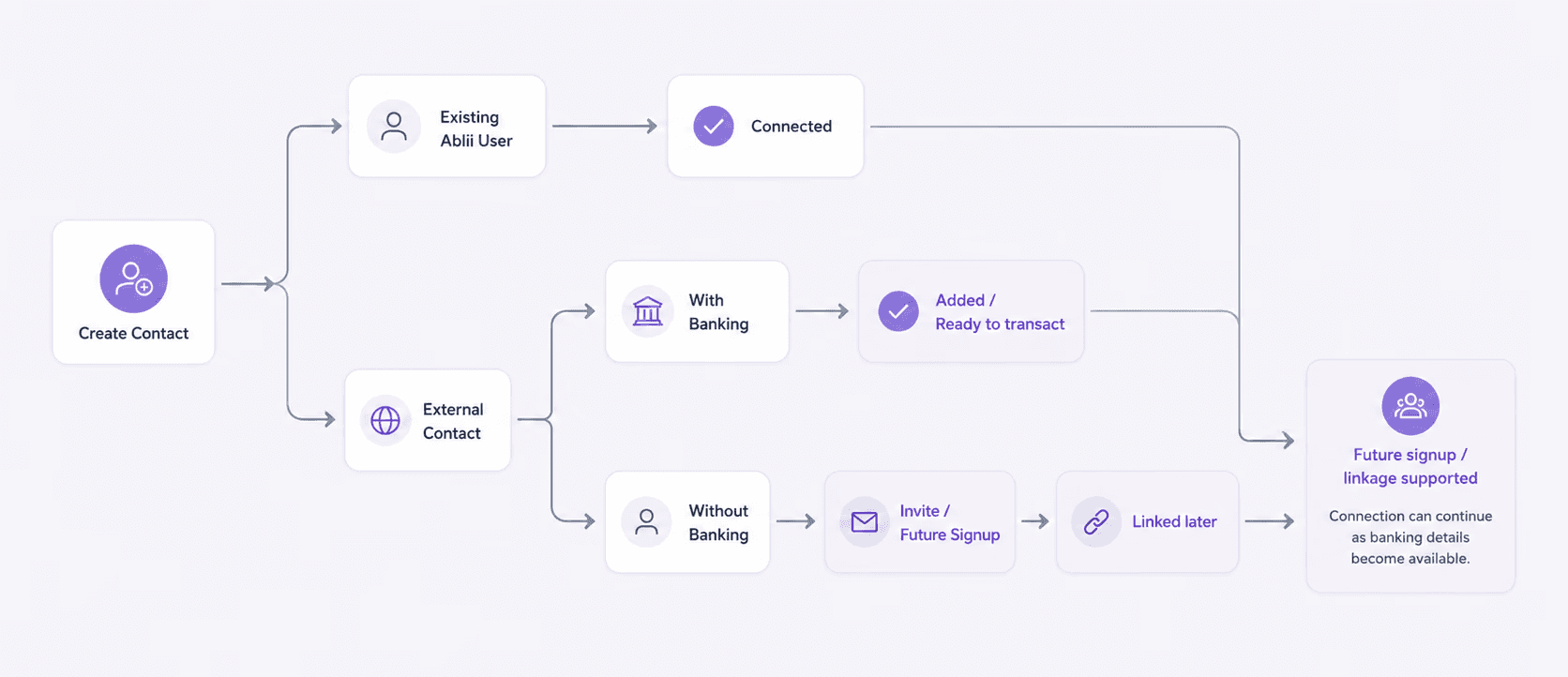
A more flexible Add Contact model
A simplified view of how existing users and external contacts could move through banking, signup, and future account states.

One identifier across multiple connection states
Connect Code created a shared identity layer across external contacts, private businesses, and public businesses.

Supporting different privacy states
Public and private businesses could connect through the same model while keeping different levels of discoverability and control.
One connection model for multiple user states
Key insight
The strongest solution wasn’t another onboarding flow—it was giving the relationship a persistent identity of its own.